
"if a 0.1mm paper is folded 100 times then what will be the thickness of it after 100 foldings?"

Thursday, March 10, 2011

Tuesday, March 8, 2011
Puzzle 6
Einstein's Puzzle
FACTS OF THE PUZZLE
[This quiz was made up by Albert Einstein and
according to him 98% will not solve it.]
There are five houses in five different colours.
In each house lives a person of a different nationality.
These five owners drink a certain beverage, smoke a
certain brand of cigarette and keep a certain pet.
No owners have the same pet, smoke the same brand
of smoke or drink the same drink.
HINTS
1] The Brit lives in the red house.
2] The Swede keeps dogs as pets.
3] The Dane drinks tea.
4] The green house is on the left of the white house.
5] The green house owner drinks coffee.
6] The person who smokes Pall Mall rears birds.
7] The owner of the yellow house smokes Dunhill.
8] The man living in the house right in the center
drinks milk.
9] The Norwegian lives in the first house.
10] The man who smokes Blend lives next to the one
who keeps cats.
11] The man who keeps horses lives next to the man
who smokes Dunhill.
12] The owner who smokes Blue Master drinks beer.
13] The German smokes Prince.
14] The Norwegian lives next to the blue house.
15] The man who smokes Blend has a neighbour who
drinks water.
The question is: WHO OWNS FISH?
[This quiz was made up by Albert Einstein and
according to him 98% will not solve it.]
There are five houses in five different colours.
In each house lives a person of a different nationality.
These five owners drink a certain beverage, smoke a
certain brand of cigarette and keep a certain pet.
No owners have the same pet, smoke the same brand
of smoke or drink the same drink.
HINTS
1] The Brit lives in the red house.
2] The Swede keeps dogs as pets.
3] The Dane drinks tea.
4] The green house is on the left of the white house.
5] The green house owner drinks coffee.
6] The person who smokes Pall Mall rears birds.
7] The owner of the yellow house smokes Dunhill.
8] The man living in the house right in the center
drinks milk.
9] The Norwegian lives in the first house.
10] The man who smokes Blend lives next to the one
who keeps cats.
11] The man who keeps horses lives next to the man
who smokes Dunhill.
12] The owner who smokes Blue Master drinks beer.
13] The German smokes Prince.
14] The Norwegian lives next to the blue house.
15] The man who smokes Blend has a neighbour who
drinks water.
The question is: WHO OWNS FISH?
Monday, March 7, 2011
Thank U
Thanks to one and all who made this blog successful
On 8/27/10 with great dreams and Aims. I have started this blog till
now in spite of many ups and downs. I continued it.today I felt happy
because the visitors to blog reached above 1000 (1078 ** till now)
and other surprising thing to me is that
http://www.histats.com/viewstats/?sid=1227620&act=2
your feed back is important to us :
please give your valuable feedback to us
By email :- blogece08@gmail.com
OR
click this link and fill data
https://spreadsheets.google.com/viewform?formkey=dFJuV0dZblRvR2RQWWhuLUJRdVdPOGc6MQ
yours
team blog ece
On 8/27/10 with great dreams and Aims. I have started this blog till
now in spite of many ups and downs. I continued it.today I felt happy
because the visitors to blog reached above 1000 (1078 ** till now)
and other surprising thing to me is that
| Last 2 months |
|
|
http://www.histats.com/viewstats/?sid=1227620&act=2
your feed back is important to us :
please give your valuable feedback to us
By email :- blogece08@gmail.com
OR
click this link and fill data
https://spreadsheets.google.com/viewform?formkey=dFJuV0dZblRvR2RQWWhuLUJRdVdPOGc6MQ
yours
team blog ece
puzzle-5
Critical Thinking Puzzles: An Unusual Paragraph
This is a most unusual paragraph. How quickly can you find
out what is so unusual about it? It looks so ordinary, you'd
think nothing was wrong with it. Actually, nothing is wrong
with it. But it is not as ordinary as you might think.
If you think about it for a bit, you will find out why it
is truly so unusual. So what is it? What is so unusual about
this paragraph?
Friday, March 4, 2011
A miracle rice
A miracle rice
How attractive are those emerald green fields of the Indian countryside, with waving paddy shoots modulated by even little breezes. The acres of water in which they stand tempt you to linger and inhale the cool heady smell.
Sorry to intrude, but your rice field is causing good-sized environmental violence. A kilo of rice on your table needs 5,000 litres of water to grow. And the rice plant produces a lot of methane, which is a greenhouse gas.
The good news is we may be on the threshold of being able to grow rice in a more ecologically sensible way. A new rice plant, christened Aerobic Rice has been developed that promises much. Traditional rice cultivation is termed an-aerobic because standing water causes decomposition of organic matter in the absence of oxygen and this process generates methane. It is estimated that up to 25% of all methane generated in the world is from rice fields.
But aren’t flooded fields required to grow paddy? Well, no, not if you grow the right kind of rice. And there were in India, several strains of rice that grew well with little water. How? They had strong and vigorous root systems that absorbed moisture from below the surface.
The Green Revolution is lazy farming with appropriate costs all around. The high yielding variety of rice that led the revolution, had short roots which had to be pampered with water without it having to make the effort. Ergo, flooded fields. This was deemed good plant efficiency, when measured in terms of rice yield per given weight of plant. But no one worked out total efficiency and cost of agriculture. Floods of water, energy to pump it, fertilisers and pesticides to force feed the plant and keep it alive, the net profit to the farmer and of course the net loss to the planet in terms of methane generation were not reckoned with. Even worse, where once farmers grew rain-fed rice and other crops that needed little water, they now came to believe agriculture was not possible without a river or a well near puddled fields. Large acreages that were once farmed were abandoned.
The search for a rice that yielded good profit with little water began six years ago. According to a report in 2002, five Indian institutions and 20 scientists began work under a $350,000 grant from the Rockefeller Foundation. They began with 3,000 native genes from which 800 were found promising. Then hybridisation of various combinations were tried.
In Nov 2006, Prof H E Shashidar of the University of Agricultural Sciences [UAS], Bangalore, one of the five institutions doing research, announced the development of Aerobic Rice. This has three times the length of currently cultivated rice strains, requires half the water and yields are about the same. It can grow in purely rain-fed conditions, can be broadcast directly in the fields which means the cost of transplanting is avoided. With reduced labour and energy costs, net profit for the farmer increases. Being aerobic, methane generation is nearly nil. Anaerobic rice, standing in water and fattened by fertilisers attract pests to their succulent stalks. The miracle -aerobic- rice is austere and so pests keep off. An added bonus is that aerobic rice growers may get an additional income by claiming carbon credits.
UAS has developed six types of aerobic rice that are set to be released to farmers in the coming year which could lead agriculture in a wholesome direction.
PUZZLE-4
Solve the murder mystery
A man was found murdered on Sunday morning. His wife
immediately called the police. The police questioned the
wife and staff and got their alibis:
The Wife said she was sleeping.
The Cook was cooking breakfast.
The Gardener was picking vegetables.
The Maid was getting the mail.
The Butler was cleaning the closet.
The police instantly arrested the murdered.
Who did it and how did they know?
Thursday, March 3, 2011
Field Effect Transistor:
Field Effect Transistor:
The field effect transistor is a semiconductor device, which depends for its operation on the control of current by an electric field. There are two of field effect transistors:
1. JFET (Junction Field Effect Transistor)
2. MOSFET (Metal Oxide Semiconductor Field Effect Transistor)
The FET has several advantages over conventional transistor.
1. In a conventional transistor, the operation depends upon the flow of majority and minority carriers. That is why it is called bipolar transistor. In FET the operation depends upon the flow of majority carriers only. It is called unipolar device.
2. The input to conventional transistor amplifier involves a forward biased PN junction with its inherently low dynamic impedance. The input to FET involves a reverse biased PN junction hence the high input impedance of the order of M-ohm.
3. It is less noisy than a bipolar transistor.
4. It exhibits no offset voltage at zero drain current.
5. It has thermal stability.
6. It is relatively immune to radiation.
The main disadvantage is its relatively small gain bandwidth product in comparison with conventional transistor.
Operation of FET:
Consider a sample bar of N-type semiconductor. This is called N-channel and it is electrically equivalent to a resistance as shown in fig. 1.
Fig. 1
Ohmic contacts are then added on each side of the channel to bring the external connection. Thus if a voltage is applied across the bar, the current flows through the channel.
The terminal from where the majority carriers (electrons) enter the channel is called source designated by S. The terminal through which majority carriers leaves the channel is called drain and designated by D. For an N-channel device, electrons are the majority carriers. Hence the circuit behaves like a dc voltage VDS applied across a resistance RDS. The resulting current is the drain current ID. If VDS increases, ID increases proportionally.
Now on both sides of the n-type bar heavily doped regions of p-type impurity have been formed by any method for creating pn junction. These impurity regions are called gates (gate1 and gate2) as shown in fig. 2.

As with all PN junctions, a depletion region is formed on the two sides of the reverse biased PN junction. The current carriers have diffused across the junction, leaving only uncovered positive ions on the n side and negative ions on the p side. The depletion region width increases with the magnitude of reverse bias. The conductivity of this channel is normally zero because of the unavailability of current carriers.
The potential at any point along the channel depends on the distance of that point from the drain, points close to the drain are at a higher positive potential, relative to ground, then points close to the source. Both depletion regions are therefore subject to greater reverse voltage near the drain. Therefore the depletion region width increases as we move towards drain. The flow of electrons from source to drain is now restricted to the narrow channel between the no conducting depletion regions. The width of this channel determines the resistance between drain and source.
Consider now the behavior of drain current ID vs drain source voltage VDS. The gate source voltage is zero therefore VGS= 0. Suppose that VDS is gradually linearly increased linearly from 0V. ID also increases.
Since the channel behaves as a semiconductor resistance, therefore it follows ohm's law. The region is called ohmic region, with increasing current, the ohmic voltage drop between the source and the channel region reverse biased the junction, the conducting portion of the channel begins to constrict and ID begins to level off until a specific value of VDS is reached, called the pinch of voltage VP. At this point further increase in VDS do not produce corresponding increase in ID. Instead, as VDS increases, both depletion regions extend further into the channel, resulting in a no more cross section, and hence a higher channel resistance. Thus even though, there is more voltage, the resistance is also greater and the current remains relatively constant. This is called pinch off or saturation region. The current in this region is maximum current that FET can produce and designated by IDSS. (Drain to source current with gate shorted). | 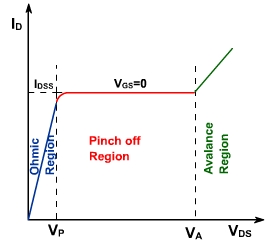 |
As with all pn junctions, when the reverse voltage exceeds a certain level, avalanche breakdown of pn junction occurs and ID rises very rapidly as shown in fig. 3.
Consider now an N-channel JFET with a reverse gate source voltage as shown in fig. 4.
 Fig. 4 |  |
The additional reverse bias, pinch off will occur for smaller values of | VDS |, and the maximum drain current will be smaller. A family of curves for different values of VGS(negative) is shown in fig. 5.
Suppose that VGS= 0 and that due of VDS at a specific point along the channel is +5V with respect to ground. Therefore reverse voltage across either p-n junction is now 5V. If VGS is decreased from 0 to –1V the net reverse bias near the point is 5 - (-1) = 6V. Thus for any fixed value of VDS, the channel width decreases as VGS is made more negative.
Thus ID value changes correspondingly. When the gate voltage is negative enough, the depletion layers touch each other and the conducting channel pinches off (disappears). In this case the drain current is cut off. The gate voltage that produces cut off is symbolized VGS(off) . It is same as pinch off voltage.
Since the gate source junction is a reverse biased silicon diode, only a very small reverse current flows through it. Ideally gate current is zero. As a result, all the free electrons from the source go to the drain i.e. ID = IS. Because the gate draws almost negligible reverse current the input resistance is very high 10's or 100's of M ohm. Therefore where high input impedance is required, JFET is preferred over BJT. The disadvantage is less control over output current i.e. FET takes larger changes in input voltage to produce changes in output current. For this reason, JFET has less voltage gain than a bipolar amplifier.
Subscribe to:
Posts (Atom)